(part of The Darkness Visible series)
In every pogrom there is a moment where the victimized community has to stop and ask themselves just how far this new wave of violence is going to go. Moments of terror crack like thunder in the hearts of those who wait to see if the violence will escalate further. These moments reverberate through the community in such a manner that one family's loss quickly becomes the sorrow of every household. As the blood continues to pour and the tragic losses continue to mount, the fear grows till it floods the hearts and souls of all those trapped by the violence.
At some point what starts as a one pogrom in one village or town tends to spread outward. With news of freshly spilled blood traveling faster today than ever before this tidal wave of terror rushes across the map. It breaks through every previous barrier that had once contained these outbreaks of savage violence. And the world now has no way of denying what we can all see so painfully clear.
Violence breeds more of itself. It feeds on the fear it creates within the communities it rips apart. With each outbreak it grows more brazen. Areas afflicted with genocide quickly become helpless to stop its spread as they buckle beneath it's weight. Unless those watching from the sidelines step in to break the cycle, this senseless violence will continue till it burns itself up and there is nothing left.
Rohingya Blogger has recently brought to light clear cases of pogroms that are rapidly spreading such terror across Maungdaw in the Arakan state of Myanmar. These incidents are brutal and savage cases of inhuman barbarism. They show the worst side of humanity as extreme elements of Burma's society work toward some of the darkest political and religious goals man could ever set. They show clear cases of genocidal intent to cleanse Burma of the Rohingya people through violent expulsion and/or outright slaughter.
On Monday (January 13th) Rohingya Blogger posted a piece by Democratic Voice of Burma that showed how the death of one man in Meikhtila had sparked "rumors that an outbreak of communal violence was imminent". Despite the police saying that this death was a family dispute and in no way connected to the racial divide within the community itself, there were concerns amongst some of Meikhtila's citizens. Only time, however, will tell if the spread of violence in other areas had anything to do with the spread of these rumors or if it is mere coincidence.
What we do know right now is that in the Arakan the thunder is rolling and the blood is spilling. There is no denying in these recent cases that the religious and ethnic divide is behind the new blood baths currently taking place. And despite Burma's best attempts to hide it's complete disregard to "restoring peace" the news of these pogroms is getting out. This is in part due to the diligence of dedicated screamers like those at Rohingya Blogger.
On January 13th Maungdaw once again felt the first drops of blood as the pogroms began.
Rohingya Blogger reported (here) that on the night of January 13th, around 11pm, a police sergeant along with three police officers, the village administer, and five Rakhinese men entered Eastern Duchiradan village. Upon their arrival the group appears to have set out to spread terror amongst the Rohingya citizens. Their offenses included rape, looting of Rohingya property, and ultimately the killing of three Rohingya (including the rape victim). All of which was clearly meant to show the Rohingya that such acts are protected and collaborated with by the police themselves. There will be no legal reprisals or protection here.
This report by Rohingya Blogger was rapidly followed by even more detailed accounts of the extent of the pogrom in Duchiradan village. Reporting (here) from Rohingya Blogger spells out the atrocities that continued to mount in this now abandoned village. From the accounts given the Rohingya of Duchiradan have suffered mass executions, rapes, mutilations, torture, and mass arrests. Bodies of the slain, in customary form for Myanmar's officials, were taken from public view and buried in unmarked locations.
Today Duchiradan village is reported to be abandoned. The Rohingya who survived the pogrom have left their homes and joined the ever growing numbers of internally displaced peoples (IDPs) of Myanmar's Arakan state. Forced from their homes, these Rohingya were by all definitions ethnically cleansed from their village as the Rakhine (supported by Burmese police) take control of the area. This act is by definition genocide.
However this is not the only pogrom in the Maungdaw region.
Rohingya Blogger reported (here) that on January 15th in Baggona village tract a group of about 50 Rakhine attack Rohingya farm plots. The ethnic violence there has been growing as Rakhine from Kaye Myaing village reportedly carry out attacks against the Rohingya village of Baggona without intervention by Burmese police. The attacks are growing from property damage to physical assaults and prolonged torture of Rohingya caught by Rakhine mobs.
Terror is a weapon in and of itself. In Baggona the attacks not only deprive Rohingya of food security but also create a situation in which Rohingya farmers are terrified of returning to their fields. This lack of defense means that any Rohingya who wants to eat must risk violent attack or even death as Rakhine assailants attack with impunity. The terror that is created spreads as Rohingya notice both their vulnerability and a shrinking food supply (already minimal).
Yet the pogroms don't end here... after all, violence only breeds more of itself...
In another report Rohingya Blogger shared (here) a press release by BROUK about a pogrom in Kiladaung village on January 13th. In this press release are detailed accounts of Burmese military and security forces actively participating in the slaughter of seven Rohingya (including women and children) and the mass arrests of 100 Rohingya. It shows clearly that government forces within the Arakan state are actively participating in a campaign of ethnic cleansing intended to ultimately end their genocidal ambitions.
It is clear that the violence against Rohingya in the Arakan is once again reaching a flash point like those seen during the summer and fall of last year. And just as before, these incidents of government backed ethnic cleansing will not end without the direct and deliberate action by the world community and/or United Nations. If no external governmental organization intervenes this thunder will only grow into a raging storm... a storm that threatens the existence of a people, a culture, and their heritage.
For all you screamers who are reading this we are once again asking that you raise your voice in any way you can. Tweet, use status updates on Facebook, Instagram if you got it, Tumblr if you still use it, and any other social media site you can get your voice heard on. Yet we also ask that once you have screamed on there that you take that passion and start harassing your representatives in your respective government. Take that passion and petition your churches, your mosque, your temples and get them involved with organizations like Partners Relief and Development (info here). Use your outrage and get creative... if there is somebody who will listen (or that you can force to listen) then get out there and scream so that they will know.
Your voice is a weapon far greater than that of the terror these perpetrators of genocide are using. This indignant sense of moral outrage can be yielded just as effectively as any weapon of war. All it takes is for you to find your outlet and start applying yourself. It isn't always easy, it isn't always comfortable, but it is absolutely vital.
Come scream with us on twitter to learn more...
Find us at: @alders_ledge and @AL_Staff
Notes:
Rohingya Blogger
http://www.rohingyablogger.com/2014/01/police-and-rakhines-loot-and-rape-3.html#
-
http://www.rohingyablogger.com/2014/01/rakhine-extremists-destroy-vegetable.html
-
http://www.rohingyablogger.com/2014/01/press-release-7-rohingyas-killed.html
-
http://www.rohingyablogger.com/2014/01/duchiradan-village-deserted-after.html
Partners Relief and Development
http://partnersworld.org/
Showing posts with label Rakhine. Show all posts
Showing posts with label Rakhine. Show all posts
January 15, 2014


August 20, 2013
Stealing Their Heritage
Myanmar's Slow Genocide
(The Darkness Visible series)

When a tyrant finds that they can no longer effectively kill off a targeted community the endgame scenario they often turn to is no less atrocious then the original sin. It is an option for genocidal regimes that has been a persistent fix all throughout the history of genocide. For the Germans it was the cattle car solution to the "Jewish Question". In Armenia it was defined by death marches into the wilderness where the victims were made to suffer a slow death if not immediately executed. And in Myanmar it is expressed clearly in the eyes of every "refugee" created through the government's barbarism.
When Hitler laid out his 'Final Solution' to the 'Jewish Question' he did so with the same vitriol that can be heard in Thein Sein's voice when talking about Myanmar's Rohingya question. The hatred that spewed forth in Mein Kamph can be read in every sentence that has come forth from Thein Sein when addressing the "issue" of Rohingya in Myanmar. It isn't enough that the man calls an entire ethnic group and "issue" but that he feels a need to find a "solution" to them. This is the nature of Burma's endgame.
It is not beyond reason to imagine that if Myanmar cannot deport enough Rohingya fast enough (before the next elections) that Thein Sein could look toward more "spontaneous" actions to reduce the Rohingya population. But for now the endgame solution that Burma has chosen to move forward with is that of deportations and concentration camps. The relationship between the two methods is vital to the endgame that Thein Sein's regime (note that Thein Sein is a puppet to a military backed government) has chosen for the genocide of the Rohingya people.
Deportations are a complex operation when carried out by the state. It has historically been shown that the leaders of such crimes feel a compulsion to document the events a dozen different ways. States compelled to expel ethnic groups in mass seems to need such documents to prove the enemy is really gone. But for whatever reason, the removal is always capable of being proven through the perpetrators' own accounts.
One way to organize these crimes has been to first create ghettos, concentration camps, or detention centers of some sort. These facilities, no matter how inhumanely constructed, are vital to the efforts by states to expel any portion of their population. It helps to confine the members of a targeted group so as to prevent people from escaping what they might rightfully perceive as a slow form of death. It also frees up land and property that was owned or occupied by the targeted group.
Once the ghettos are created the state can take an inventory of their victims. The Germans used tattooing to identify victims as they were deported to death camps outside the view of the rest of society. The Ottomans used decapitations and kill houses to count off the dead so as to keep track of how many Armenians they had removed from the empire. Yet in every case the use of some form of confinement has offered the state an opportunity to commit even more atrocities then before.
For the Rohingya the inhumane confinement of Burmese concentration camps and ghettoized villages has offered the state the chance to extort money, carry out sexualized violence, and other depravities. These crimes have all been forms of torment that have kept the Rohingya under living conditions that are meant to kill. And yet these forms of torture are not the endgame for the Rohingya as far as the Burmese regime is concerned.
In the camps there is a stalwart that the government of Myanmar cannot kill through starvation, with bullets, or through disease. It is the most basic refuge of what makes a human a human. It is the deeply planted seed of hope. It is the basic desire for life that keeps even the most anguish ridden soul alive beyond the point of rationality. In the camps there is this clinging to life that Burma's leaders have not yet been able to trample.
For this reason the government has turned to deportations. If they cannot outright kill the entire population with impunity, and death has not yet set in through mass neglect, the final solution comes in the form of removal. That is why Thein Sein, the puppet with whom the world is met, turns to propositioning the world to take the Rohingya away.
In the words of this tyrannical government rest a message that the world will be fullish to so passively overlook. In the offers to deport the Rohingya lay the warning of what awaits those who remain. Though there is no date given in those few words, there is the intent to end this slow genocide once and for all. If the Rohingya are not allowed to be removed they will face death one way or another.
This is an ultimatum that cannot be ignored. And yet it is the rational of an unsound mind that cannot be reasoned with. We cannot accept the deportations of a people and thus end a genocide through a slightly better means then death itself. Yet the leaders of Myanmar are hinting that they will find a way to force the worlds' hand.
Deportations are already underway. Rohingya are pushed out to sea every day. They are bought and sold like cattle and sent off to lives that barely can be called living. These small scale deportations are Burma's way of testing the waters (so to speak). Our tolerance of them only emboldens the perpetrators of these crimes. Our silence helps drive the nail into their coffins.
Some Sources Used:
AFP
http://sg.news.yahoo.com/myanmar-moots-camps-deportation-rohingya-solution-093554931.html
Bangkok Post
http://www.bangkokpost.com/lite/topstories/365525/human-rights-watch-opposes-border-camps-for-rohingya
HRW
http://www.hrw.org/news/2013/08/20/thailand-release-and-protect-rohingya-boat-people
(The Darkness Visible series)

When a tyrant finds that they can no longer effectively kill off a targeted community the endgame scenario they often turn to is no less atrocious then the original sin. It is an option for genocidal regimes that has been a persistent fix all throughout the history of genocide. For the Germans it was the cattle car solution to the "Jewish Question". In Armenia it was defined by death marches into the wilderness where the victims were made to suffer a slow death if not immediately executed. And in Myanmar it is expressed clearly in the eyes of every "refugee" created through the government's barbarism.
Slow Genocide
"We will take responsibility for our ethnic people but it is impossible
to accept the illegally entered Rohingyas, who are not our ethnicity," ~Thein Sein
Genocide is defined as the deliberate killing of members of an ethnic, religious, or national group with intent to destroy the group in part or in whole. It can include the imposing of living conditions meant to bring about the death or deterioration of the group in any capacity. This means that the deportations of members of the group can be interpreted as intent to impose living conditions that would destroy the group in part or in whole. For this reason the use of deportations on any scale is a tactic of savagery by a state that can legally be defined as genocide. However slow it might be... it is still genocide.
In previous post we have explored the intent on Myanmar's part to create refugees of it's minority populations with intent of "ethnically cleansing" it's lands of said groups. Though there are arguments amongst some about the supposed difference between ethnic cleansing and outright genocide, it is the opinion of this blog that the two are the same crime regardless. For that reason the use of such tactics on the part of Myanmar constitute a history of genocide and the continuation of it when dealing with all it's minority groups.
For the Rohingya this slow bleed has been up to this point has been a genocide characterized by pogroms designed to look like "flash point" events of ethnic unrest. These supposed spontaneous attacks have been accompanied by military action that rapidly follows up behind state supported Rakhine mobs. Where the civilian attackers cannot finish the job the Burmese military picks up the slack. This cooperation shows that despite the appearance of spontaneity, the attacks are often organized and carried out in the same military fashion Myanmar has displayed in the Shan and Kachin states.
The initial blitz approach to genocide lost steam as the world turned it's eyes upon the newly "democratic" Myanmar. Feeling the pressure to maintain appearances, Burma turned away from outright slaughter and moved toward a slower version of death. Rohingya were rapidly placed into concentration camps without regard to living conditions for the Rohingya themselves. This aspect of organizing IDP camps that would bring about disease, starvation, and eventual death should had shown the intent of genocide on Myanmar's part. But the world looked the other way as Burma sealed off Rohingya villages and created the ghettos that Poland once endured.
During this entire campaign of slowing down the death toll in the Arakan state the government of Burma expressed a desire to begin deportations. Under the Nasaka small scale deportations did exist. Yet with the old SA gone and the new SS building up it's numbers, the deportations have all but ended. Border security in Myanmar still utilizes human traffickers to deport the Rohingya in boats and along dangerous paths into neighboring countries. This turns a profit for the corrupt Myanmar regime while at the same time fulfilling the government's desire to ethnically cleanse the Arakan.
Endgame
"We will send them away if any third country would accept them," Thein Sein. "This is what we are thinking is the solution to the issue."
When Hitler laid out his 'Final Solution' to the 'Jewish Question' he did so with the same vitriol that can be heard in Thein Sein's voice when talking about Myanmar's Rohingya question. The hatred that spewed forth in Mein Kamph can be read in every sentence that has come forth from Thein Sein when addressing the "issue" of Rohingya in Myanmar. It isn't enough that the man calls an entire ethnic group and "issue" but that he feels a need to find a "solution" to them. This is the nature of Burma's endgame.
It is not beyond reason to imagine that if Myanmar cannot deport enough Rohingya fast enough (before the next elections) that Thein Sein could look toward more "spontaneous" actions to reduce the Rohingya population. But for now the endgame solution that Burma has chosen to move forward with is that of deportations and concentration camps. The relationship between the two methods is vital to the endgame that Thein Sein's regime (note that Thein Sein is a puppet to a military backed government) has chosen for the genocide of the Rohingya people.
Deportations are a complex operation when carried out by the state. It has historically been shown that the leaders of such crimes feel a compulsion to document the events a dozen different ways. States compelled to expel ethnic groups in mass seems to need such documents to prove the enemy is really gone. But for whatever reason, the removal is always capable of being proven through the perpetrators' own accounts.
One way to organize these crimes has been to first create ghettos, concentration camps, or detention centers of some sort. These facilities, no matter how inhumanely constructed, are vital to the efforts by states to expel any portion of their population. It helps to confine the members of a targeted group so as to prevent people from escaping what they might rightfully perceive as a slow form of death. It also frees up land and property that was owned or occupied by the targeted group.
Once the ghettos are created the state can take an inventory of their victims. The Germans used tattooing to identify victims as they were deported to death camps outside the view of the rest of society. The Ottomans used decapitations and kill houses to count off the dead so as to keep track of how many Armenians they had removed from the empire. Yet in every case the use of some form of confinement has offered the state an opportunity to commit even more atrocities then before.
For the Rohingya the inhumane confinement of Burmese concentration camps and ghettoized villages has offered the state the chance to extort money, carry out sexualized violence, and other depravities. These crimes have all been forms of torment that have kept the Rohingya under living conditions that are meant to kill. And yet these forms of torture are not the endgame for the Rohingya as far as the Burmese regime is concerned.
In the camps there is a stalwart that the government of Myanmar cannot kill through starvation, with bullets, or through disease. It is the most basic refuge of what makes a human a human. It is the deeply planted seed of hope. It is the basic desire for life that keeps even the most anguish ridden soul alive beyond the point of rationality. In the camps there is this clinging to life that Burma's leaders have not yet been able to trample.
For this reason the government has turned to deportations. If they cannot outright kill the entire population with impunity, and death has not yet set in through mass neglect, the final solution comes in the form of removal. That is why Thein Sein, the puppet with whom the world is met, turns to propositioning the world to take the Rohingya away.
In the words of this tyrannical government rest a message that the world will be fullish to so passively overlook. In the offers to deport the Rohingya lay the warning of what awaits those who remain. Though there is no date given in those few words, there is the intent to end this slow genocide once and for all. If the Rohingya are not allowed to be removed they will face death one way or another.
This is an ultimatum that cannot be ignored. And yet it is the rational of an unsound mind that cannot be reasoned with. We cannot accept the deportations of a people and thus end a genocide through a slightly better means then death itself. Yet the leaders of Myanmar are hinting that they will find a way to force the worlds' hand.
Deportations are already underway. Rohingya are pushed out to sea every day. They are bought and sold like cattle and sent off to lives that barely can be called living. These small scale deportations are Burma's way of testing the waters (so to speak). Our tolerance of them only emboldens the perpetrators of these crimes. Our silence helps drive the nail into their coffins.
A Plea... A Scream.
I will close this post in a way that many of Alder's Ledge's contributors have heard time and time again. It is a story that has tainted post after post here on this blog. And though I don't talk about it near as often as some might want... it is a story that best sums up why Alder's Ledge has kept it's voice raised for so long.
I have said before that I can see the faces of my ancestors in the stories that come out of Burma. Time and time again I have faced a part of my own past in a land I knew nothing about just a couple years ago. It has bonded me to a people that I may never get the chance to meet in person. It has connected me to a struggle that many have never heard about. For this reason I scream.
When the Germans entered Croatia they stole from me something that I hadn't even been given yet, my heritage. The holocaust of my ancestors took from my family the will to identify with their past. It stole from them their name, their lineage, their history. For that reason I lost entire portions of a history that I have fought to restore my entire life. It is a battle that led to Alder's Ledge's creation in the first place. It is the heart and soul of why this blog exist. And it is the blood in our cracked voices as we scream for those suffering that same fate.
I know that many who read this blog don't have that scar to keep them entangled in what can be easily written off as "someone else's fight". It isn't easy to deal with genocide no matter what you own history with it might be. And it certainly isn't a topic that we often think about bringing up, let alone as often as this blog does.
But I would like to make this plea once again.
When I look at Burma I see entire masses of people being forced into the struggle I have faced since my eyes were first opened. What is being stolen from them isn't something that they will ever be able to restore to the way it was prior to all this. Many of them are already a generation or two into this battle to hold onto their heritage. Their mothers, their fathers, and for some their grandparents... all watch as their children are robbed of their culture, their history, their family.
There is no good way to describe the suffering that comes along with this. Anger, hatred... both taint the soul as a person fights to take back what they were denied so violently. For some, those emotions never succumb to the love for life that they feel was crushed beneath the heels of their assailants.
For me this is just a little of why I fight. It is what motivates these post. And hopefully, the heart of this has been seen in every word.
Now I would like to ask that those reading this put these post into their own words... with your own heart. Take everything you can from these articles and utilize them to get the message out. Don't let your voice be silent as the Rohingya people are robbed of their humanity. Scream with us. Join us. Fight with us.
Want to learn how you can help?
Contact @alders_ledge on Twitter
Or contact us on FaceBook: Alder's Ledge
Some Sources Used:
AFP
http://sg.news.yahoo.com/myanmar-moots-camps-deportation-rohingya-solution-093554931.html
Bangkok Post
http://www.bangkokpost.com/lite/topstories/365525/human-rights-watch-opposes-border-camps-for-rohingya
HRW
http://www.hrw.org/news/2013/08/20/thailand-release-and-protect-rohingya-boat-people
August 6, 2013
Raised By The System
Now It's Time To Rise Against Them
(The Darkness Visible series)
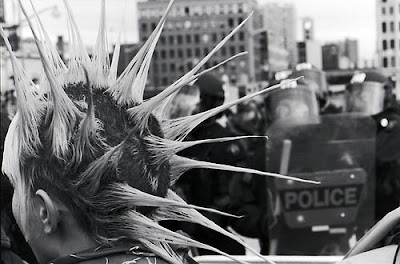
When nobody else will speak out against an apparent wrong there is always someone that will do something out of the ordinary. Crossing the lines that we in society draw between what we know is right and what we will actually do to stop evil, this individual is the misfit. They trample upon the status quo without regard for their own image. Standing up for what they know is right, this one person refuses to follow societies lead. In the West these people, the ones that rock the boat, are often referred to as punks.
In the 80's this rebellious spirit was harnessed by a musical movement that would give punks their fashion. Spikes, leather, studs, and chains all replaced the soft resistance to conformity that had followed the 60's and 70's. Like a fire, the spirit of the punk movement burnt away that which held us to a system that robbed us of everything that made us unique. For this desire to be free at last we turned to anarchy.
30 years later the punk is still alive within the hearts and minds of those who shrugged off the image of what society wanted them to be. Now new generations of punks replace those who came before them. The music, the fashion, the spirit is still fast, violent, and loud.

This spirit of anarchy can be seen in Burma amongst a brave few. These punks live under one of the most oppressive governments the world has to offer. Their society is as tightly wound as it can possibly be with police given almost complete impunity. The military still has every right to round up any citizen at any time and simply make people disappear. Yet the punk spirit rises out of Burma like a phoenix.
In a country where the national religion, Buddhism, is considered an integral part of national identity the willingness to speak out against Buddhist extremist is shocking. It is even more shocking to Burmese society when someone is willing to speak out against the most revered members of Burmese society... the monks. And that is exactly what the a handful of punk in Yangon have done.
Crossing the line between society's accepted norm and over into the realm of dissent the punks choose to speak out against the monks who have spread the 969 movement. This has put the punks of Burma in the same situation American punks faced during the 80's with a resurgence of American hate groups. Yet for Burma's punks it is a stand against the oppressor, an oppressor that they very recently knew all to well, it is a fight to the death with a system that embraces the hate group while rejecting them.
The main issue the punk movement faces in Burma is that there are many more 969 supporters and very few "punks". Burma after all is a traditionalist society. It has a long history of rejecting new aspects of social behavior. Conformity is king in a society where fear was the law of the land. Those who act out, those who behave differently, are considered outsiders. All the while those who would divide society so as to conquer it are treated as idols.
Perhaps this is the aspect of Burma that the punk scene has highlighted most. In a country where religion is given the authority to segregate there can't really be freedom. In a country where hate is fed to the masses under the guise of love there will never really be unity. Chaos and anarchy aren't likely in the streets of a police state. But they will always reside in the hearts of disenfranchised youth as long as the government clings to the chains of previous oppressive regimes.
If leaders like Aung San Suu Kyi are going to promise the everything from democracy to the moon they will find it hard to maintain the repression that has long ruled Myanmar. They will not be able to keep the influences of the free world out of their children's headphones and off the computer screens of their students. Once the images and sounds of freedom leak into the minds of the youth they become fountainheads. The tide that flows forth from this cannot be held back. It is a catalyst in societies that refuses to surrender to the will of tyrants.
This desire... this, the most natural yearning of the human spirit... for liberty is alive in the hearts of the few punks in Yangon. It prompts them to speak out when no one else wants to. It is a fire that cannot be stifled by the threat of a jackboot's heel.
For 969 and the nationalist in Myanmar's government it is a threat. Just as with all oppressors, liberty is seen as anarchy. For the fascists freedom is perceived as chaos. Proof of this can be seen in how the regime in Myanmar has responded to the Rohingya support (both in Burma and around the world).
Source Documents
(Note: Not all sources listed)
Bangkok Post
http://www.bangkokpost.com/news/asia/363116/punk-rockers-break-myanmar-silence-on-religious-attacks
Post Bulletin
http://www.postbulletin.com/entertainment/music/punks-break-myanmar-s-silence-on-religious-attacks/article_8a71a907-1fd3-514f-a33b-cdce950b0969.html
SBS News
http://www.sbs.com.au/news/article/1793794/Punk-is-alive-and-well-in-Myanmar
Irrawaddy
http://www.irrawaddy.org/archives/40864
(The Darkness Visible series)

''They are nationalists, fascists. No one wants to hear it, but it's true."
~ Kyaw Kyaw, lead singer of Rebel Riot.
When nobody else will speak out against an apparent wrong there is always someone that will do something out of the ordinary. Crossing the lines that we in society draw between what we know is right and what we will actually do to stop evil, this individual is the misfit. They trample upon the status quo without regard for their own image. Standing up for what they know is right, this one person refuses to follow societies lead. In the West these people, the ones that rock the boat, are often referred to as punks.
In the 80's this rebellious spirit was harnessed by a musical movement that would give punks their fashion. Spikes, leather, studs, and chains all replaced the soft resistance to conformity that had followed the 60's and 70's. Like a fire, the spirit of the punk movement burnt away that which held us to a system that robbed us of everything that made us unique. For this desire to be free at last we turned to anarchy.
30 years later the punk is still alive within the hearts and minds of those who shrugged off the image of what society wanted them to be. Now new generations of punks replace those who came before them. The music, the fashion, the spirit is still fast, violent, and loud.

"All I can really say is, people should look at the teachings of Buddha and ask themselves, is this what he meant?"
~ Ye Ngwe Soe, lead singer of No U Turn
This spirit of anarchy can be seen in Burma amongst a brave few. These punks live under one of the most oppressive governments the world has to offer. Their society is as tightly wound as it can possibly be with police given almost complete impunity. The military still has every right to round up any citizen at any time and simply make people disappear. Yet the punk spirit rises out of Burma like a phoenix.
In a country where the national religion, Buddhism, is considered an integral part of national identity the willingness to speak out against Buddhist extremist is shocking. It is even more shocking to Burmese society when someone is willing to speak out against the most revered members of Burmese society... the monks. And that is exactly what the a handful of punk in Yangon have done.
Crossing the line between society's accepted norm and over into the realm of dissent the punks choose to speak out against the monks who have spread the 969 movement. This has put the punks of Burma in the same situation American punks faced during the 80's with a resurgence of American hate groups. Yet for Burma's punks it is a stand against the oppressor, an oppressor that they very recently knew all to well, it is a fight to the death with a system that embraces the hate group while rejecting them.
"No fear! No indecision! Rage against the system of the oppressors!"
~ Rebel Riot
The main issue the punk movement faces in Burma is that there are many more 969 supporters and very few "punks". Burma after all is a traditionalist society. It has a long history of rejecting new aspects of social behavior. Conformity is king in a society where fear was the law of the land. Those who act out, those who behave differently, are considered outsiders. All the while those who would divide society so as to conquer it are treated as idols.
Perhaps this is the aspect of Burma that the punk scene has highlighted most. In a country where religion is given the authority to segregate there can't really be freedom. In a country where hate is fed to the masses under the guise of love there will never really be unity. Chaos and anarchy aren't likely in the streets of a police state. But they will always reside in the hearts of disenfranchised youth as long as the government clings to the chains of previous oppressive regimes.
If leaders like Aung San Suu Kyi are going to promise the everything from democracy to the moon they will find it hard to maintain the repression that has long ruled Myanmar. They will not be able to keep the influences of the free world out of their children's headphones and off the computer screens of their students. Once the images and sounds of freedom leak into the minds of the youth they become fountainheads. The tide that flows forth from this cannot be held back. It is a catalyst in societies that refuses to surrender to the will of tyrants.
This desire... this, the most natural yearning of the human spirit... for liberty is alive in the hearts of the few punks in Yangon. It prompts them to speak out when no one else wants to. It is a fire that cannot be stifled by the threat of a jackboot's heel.
For 969 and the nationalist in Myanmar's government it is a threat. Just as with all oppressors, liberty is seen as anarchy. For the fascists freedom is perceived as chaos. Proof of this can be seen in how the regime in Myanmar has responded to the Rohingya support (both in Burma and around the world).
“I also use a laptop secretly, everybody uses a laptop secretly..."
~ Rohingya Activist in hiding.
In an effort to stop the flow of information out of concentration camps in the Arakan state the Burmese government during the last week of July raided countless camps. They weren't looking for papers or letters. They weren't looking for particular individuals per say. These stormtroopers were after the new age version of Anne Frank's diary... laptops and smart phones. Like the SS looking to seal off the ghettos in Poland, Burma's military set out to confiscate electronic communications that could possibly reach foreigners.
This practice fits Burma's old junta style government well. In the past the Burmese military had pushed refugees right out to the border only stopping when foreigners could see their soldiers' atrocious behavior. The confiscating of computers and laptops shows the desire to keep the outside eyes from seeing what is going on inside camps that the UN called "inhumane". It shows a desire on the part of Burma to silence the already voiceless Rohingya people. And even more sinisterly it shows a government prepping camps for liquidation.
This is the government and it's actions that the punks of Yangon so boldly spoke out against. Though just two years ago they would had all been rounded up and taken to prison without question, they spoke out anyway. Even though nobody really knows where the line between the old regime's censorship and the new regimes patience is really drawn, they spoke out anyway. They spoke out against the savaging of Rohingya women and children by Myanmar's military. They spoke out against the pogrom of Rohingya villages in the name of Buddhism. They spoke out because no one else would.
In a world where nobody is willing stand up to jackbooted thugs it is at very least reassuring to know that a handful of punks will.
Want to learn more about the Rohingya and their plight at the hands of Burmese nationalist?
Follow us on Twitter: @Alders_Ledge
Follow us on Facebook: Alder's Ledge
Source Documents
(Note: Not all sources listed)
Bangkok Post
http://www.bangkokpost.com/news/asia/363116/punk-rockers-break-myanmar-silence-on-religious-attacks
Post Bulletin
http://www.postbulletin.com/entertainment/music/punks-break-myanmar-s-silence-on-religious-attacks/article_8a71a907-1fd3-514f-a33b-cdce950b0969.html
SBS News
http://www.sbs.com.au/news/article/1793794/Punk-is-alive-and-well-in-Myanmar
Irrawaddy
http://www.irrawaddy.org/archives/40864
June 27, 2013
The People From Nowhere
With Nowhere To Return To
(The Darkness Visible series)

If anywhere on the planet could be described as "the middle of nowhere" the Arakan in Burma could very well be it. Since Myanmar was created it has been one of the most neglected places on the planet. Aid organizations and NGOs have long been working in Thailand to help refugees fleeing violence and war, but that is on the other side of the country. The Arakan remains isolated as it is tucked between Myanmar and Bangladesh. There it rest as a small sliver of land filled with rivers, mud, and hills. For most of the world it is might as well be on another planet.
So it is of little surprise that when genocide reappeared in the Arakan that most of the world didn't realize it... many still don't. When I ask people if they have heard of the plight of the Rohingya in Burma they often first ask where Burma is. The next question is who are the Rohingya. This is the extent of Western knowledge of Myanmar and the people it oppresses. It is one of the reasons that few in the West are taking action to stop this genocide.
The one term that brings a connection to in the minds of people I talk to is that of "boat people". The images of Burmese refugees taking to rickety boats and braving the waves to hopefully reach safety in Malaysia or Indonesia still rest in the minds of Westerners today. However most of the people in my area of the world don't make the connection between Muslim Rohingya and "boat people" right away. Usually it takes a good deal of explaining to convince people that the Muslims are not the ones committing genocide and creating "boat people" but rather are the refugees. It is this awkward connection between the name Rohingya and "boat people" with which I have been able to describe what "nowhere" is like for these fleeing refugees.
I have come to view the Arakan as being somewhat of "the middle of nowhere" for Rohingya because they aren't legally part of it. Though they have lived there for countless generations and have a strong heritage in the Arakan, the government of Burma claims they are "Bengali invaders". For this reason the Rohingya are homeless in their own homeland. Without citizenship in their own country the Rohingya might as well be anywhere else on the globe than right there at home. And yet they have nowhere else to go.
Those who flee from decades of oppressive rule and modern outbreaks of organized violence are left without a place to which someday return. Due to their lack of Burmese citizenship they have nowhere left to call home. Countries like Thailand, Malaysia, Bangladesh, and Indonesia have nowhere to send them home to once they arrive. Those who flee this new wave of genocide enter a state of limbo... a state of unlawful existence according to the countries in which they end up.
The country from which these Rohingya refugees flee is a country where they are targeted for mass executions, slave labor, starvation, and exploitations of all the usual deviant ways. They cannot return to Myanmar with any hopes of a free and dignified life. With hate speech readily preached against them across their homeland, with the threat of more pogroms, and with the reality of starvation and isolation; the Rohingya who flee Burma become people with nowhere to call home.

For the Rohingya the place that has driven large numbers of them to flee as refugees the place they called home is hellish at best. In June of 2012 their Rakhine neighbors seemed to suddenly realize that Myanmar's "civilian" (an ex-general is President) government was just as xenophobic as the junta had been. Only now the civilians in charge were less likely to stop violence against minorities than their military predecessors had been. All it took was one spark for all hell to break lose.
With the excuse of one Buddhist woman's death the radicalized sect of Buddhism in the Arakan region took to violence instead of the preachings of their Buddha. Arming themselves with guns, knives, and machetes the mobs began to target all Muslim minorities in the region. The Rohingya were prime targets since their typically darker skin and religion made them distinctly different from the Rakhine Buddhists. These few minor differences meant that entire Rohingya villages were easily targeted by torch wielding mobs intent upon slaughtering any Muslims they could catch.
An eye for an eye. Tooth for a tooth. The Rakhine extremist would exact revenge for the unconfirmed death of a Buddhist woman with such ferocity that no Rohingya person was or is safe today. The need to defend "their people" from "Bengali invaders" was forced upon the rest of the population of the Arakan. People who had been neighbors for years were now enemies due to nothing more than their ethnicity and religion.
This unimaginable hatred is what makes the Arakan a place worthy of being considered "nowhere". When violence is justified through the simplistic view of "us verses them" nobody is safe. When one house is burned, when one life is stolen, there will always be a victim's relative, or friend, or neighbor who is willing to take it upon themselves to exact revenge. It is in this cycle of violence that the Arakan has become a place where no one can truly consider it home.
When the government did show up it rounded the Rohingya up into concentration camps. Taking the opportunity to deal with it's "Rohingya question" once and for all, Burma laid siege to the Rohingya community. Government officials allowed for Rohingya in internally displaced peoples' camps (IDP camps) to be blockaded and refused international relief. Only the most presentable camps, considered wretched and squalid by NGOs, were allowed visitors from the outside world. And even in these concentration camps the Rohingya were found to be starving to death.
This is what nowhere is like for the Rohingya. It is a country where their homes have been burned, where those still left in their villages are kept prisoners by the government, where their children starve due to neglect by Burmese officials... this is nowhere for them to call home.
Yet these are just a handful of the 20,000 estimated Rohingya who fled so far this boat season. For the rest there is still the threat of exploitation at the hands of human traffickers. Many of which are subjected to trafficking before they even leave Myanmar itself.
Growing concern for these refugees has been fueled by reports that ethnic armies in Burma have engaged in trafficking of Rohingya trying to flee the violence in Burma. This was reported in the Trafficking In Persons report by the United States this year. It stated that the Democratic Karen Benevolent Army had willfully trafficked Rohingya refugees in both Thailand and Myanmar. Other groups have been known to traffic Rohingya along the borders with China and Bangladesh as well. All of these victims are extorted of money and valuables before being either abandoned or sold to traffickers across the border in the destination country.
Then there has been the issue of Rohingya women being trafficked across Southeast Asia as mail-order brides and sex slaves. Many of these women and girls are taken from the areas hardest hit by the genocide back in Burma. They are sold by "brokers" who then ship them to Bangladesh, Malaysia, and Thailand. From there it is anyone's guess where the Rohingya girls end up. One can only imagine the life these girls are forced to live once they are snatched up from the middle of nowhere and sent away from what family they have left.
For most of the civilized world it is obvious that if a refugee manages to escape the repressive hold of a tyrannical system they should be given an opportunity to taste freedom. However the government of Thailand (along with others) remains of the opinion that Rohingya refugees should simply be "helped along" to their next destination. For many of the Rohingya in Thai custody this means that they will either be sent back to Burma to suffer once again or introduced to a new and equally terrifying version of hell. The willingness to purchase and sell fellow human beings will forever remain a blight upon Thai society as long as the Rohingya are trafficked by Thai officials. And the over eagerness of the Thai government in sending Rohingya back to the torment of genocide will never be forgotten.
If the Rohingya are to have any hope of a better future they must first be granted a glimmer of hope in neighboring lands. The perilous journey that many take to only be once again rejected by the world must be brought to an end. Governments however cannot be expected to alter their current stances upon the issue as long as prejudices against the Rohingya remain ingrained in the societies which they govern. People across the region in which the Rohingya find themselves must find it within themselves to set aside minor differences and take the opportunity to bring relief to a hurting people.
Though it would be ideal for Rohingya to be granted the ability to remain at home in the Arakan the current situation in Burma makes this impossible. If Thailand, Bangladesh, Malaysia, and all other host nations want to end the tidal wave of Rohingya refugees they will first have to pressure Myanmar to end this genocide. Any economic engagement with Myanmar will need to be done through the scope of how it will affect the genocide for better or worse. Governments around the world should rethink what it means to the oppressed minorities of Myanmar for them to take advantage of Burma's opening up to foreign investment. Sanctions should be reinstated and pressure should be applied both economically and militarily before Burma is allowed to return to the world stage.
As long as state sponsored genocide is being conducted in Burma there will always be Rohingya who find themselves with nowhere left to run. The waves of refugees will only increase for as long as the pains of hunger stab at their sides. This refugee crisis will only end when the genocide of the Rohingya is forcibly concluded... either the outside world or by Burma itself.
Want to learn more about this subject and others covered by Alder's Ledge?
(The Darkness Visible series)

(Rohingya Men In Thai Detention Center)
Where Is Nowhere?
If anywhere on the planet could be described as "the middle of nowhere" the Arakan in Burma could very well be it. Since Myanmar was created it has been one of the most neglected places on the planet. Aid organizations and NGOs have long been working in Thailand to help refugees fleeing violence and war, but that is on the other side of the country. The Arakan remains isolated as it is tucked between Myanmar and Bangladesh. There it rest as a small sliver of land filled with rivers, mud, and hills. For most of the world it is might as well be on another planet.
So it is of little surprise that when genocide reappeared in the Arakan that most of the world didn't realize it... many still don't. When I ask people if they have heard of the plight of the Rohingya in Burma they often first ask where Burma is. The next question is who are the Rohingya. This is the extent of Western knowledge of Myanmar and the people it oppresses. It is one of the reasons that few in the West are taking action to stop this genocide.
The one term that brings a connection to in the minds of people I talk to is that of "boat people". The images of Burmese refugees taking to rickety boats and braving the waves to hopefully reach safety in Malaysia or Indonesia still rest in the minds of Westerners today. However most of the people in my area of the world don't make the connection between Muslim Rohingya and "boat people" right away. Usually it takes a good deal of explaining to convince people that the Muslims are not the ones committing genocide and creating "boat people" but rather are the refugees. It is this awkward connection between the name Rohingya and "boat people" with which I have been able to describe what "nowhere" is like for these fleeing refugees.
I have come to view the Arakan as being somewhat of "the middle of nowhere" for Rohingya because they aren't legally part of it. Though they have lived there for countless generations and have a strong heritage in the Arakan, the government of Burma claims they are "Bengali invaders". For this reason the Rohingya are homeless in their own homeland. Without citizenship in their own country the Rohingya might as well be anywhere else on the globe than right there at home. And yet they have nowhere else to go.
Those who flee from decades of oppressive rule and modern outbreaks of organized violence are left without a place to which someday return. Due to their lack of Burmese citizenship they have nowhere left to call home. Countries like Thailand, Malaysia, Bangladesh, and Indonesia have nowhere to send them home to once they arrive. Those who flee this new wave of genocide enter a state of limbo... a state of unlawful existence according to the countries in which they end up.
The country from which these Rohingya refugees flee is a country where they are targeted for mass executions, slave labor, starvation, and exploitations of all the usual deviant ways. They cannot return to Myanmar with any hopes of a free and dignified life. With hate speech readily preached against them across their homeland, with the threat of more pogroms, and with the reality of starvation and isolation; the Rohingya who flee Burma become people with nowhere to call home.

“They should go to Bangladesh, where they came from, or they should be killed,” Hla Moe Thu, Rakhine Buddhist.
What is Nowhere Like?
With the excuse of one Buddhist woman's death the radicalized sect of Buddhism in the Arakan region took to violence instead of the preachings of their Buddha. Arming themselves with guns, knives, and machetes the mobs began to target all Muslim minorities in the region. The Rohingya were prime targets since their typically darker skin and religion made them distinctly different from the Rakhine Buddhists. These few minor differences meant that entire Rohingya villages were easily targeted by torch wielding mobs intent upon slaughtering any Muslims they could catch.
"When the wife of Mohamed Salam was found dead floating in a river, her
body carried a sinister message. She was abducted along with two of her
children in June, and Salam was later told by sympathetic Buddhists how
they had died. According to them, her captors said her breasts gave milk
to Muslim babies and her womb gave birth to future generations of
Muslims. Her breasts were then hacked off and her genitalia mutilated
with sharpened bamboo. Her teenage son was tethered to a motorbike and
dragged across a rocky road. Salam would not elaborate on how his
daughter met her end." ~ As reported by Brendan Bradly of The Daily Beast.
An eye for an eye. Tooth for a tooth. The Rakhine extremist would exact revenge for the unconfirmed death of a Buddhist woman with such ferocity that no Rohingya person was or is safe today. The need to defend "their people" from "Bengali invaders" was forced upon the rest of the population of the Arakan. People who had been neighbors for years were now enemies due to nothing more than their ethnicity and religion.
This unimaginable hatred is what makes the Arakan a place worthy of being considered "nowhere". When violence is justified through the simplistic view of "us verses them" nobody is safe. When one house is burned, when one life is stolen, there will always be a victim's relative, or friend, or neighbor who is willing to take it upon themselves to exact revenge. It is in this cycle of violence that the Arakan has become a place where no one can truly consider it home.
When the government did show up it rounded the Rohingya up into concentration camps. Taking the opportunity to deal with it's "Rohingya question" once and for all, Burma laid siege to the Rohingya community. Government officials allowed for Rohingya in internally displaced peoples' camps (IDP camps) to be blockaded and refused international relief. Only the most presentable camps, considered wretched and squalid by NGOs, were allowed visitors from the outside world. And even in these concentration camps the Rohingya were found to be starving to death.
This is what nowhere is like for the Rohingya. It is a country where their homes have been burned, where those still left in their villages are kept prisoners by the government, where their children starve due to neglect by Burmese officials... this is nowhere for them to call home.
Life On The Outside...
"Thailand should respect the basic rights of Rohingya ‘boat people’ and
stop detaining them in horrific conditions. The government should
immediately allow them to pursue their asylum claims with the UN refugee
agency"
~ Brad Adams, Human Rights Watch
For the Rohingya who make it out of Burma there is often no time to breathe a breath of freedom. In Thailand the Rohingya are vulnerable to human trafficking, at times at the hands of Thai officials themselves. Those who evade exploitation are more often than not captured by Thai police and taken to detention centers. Instead of being allowed to seek legal asylum in Thailand, these Rohingya are treated like common criminals with little regard to the tragedy that made them refugees in the first place.
Organization like Human Rights Watch have noted the horrific conditions in which Rohingya are kept in Thailand. Detention centers where 10 to 15 immigrants are supposed to be held now hold upwards of 250 men at a time. These Rohingya are kept in cages like animals. There is little room for them to sit down let alone move about. In these facilities there is no bathroom for the Rohingya men to use. They are simply locked up and forgotten about.
For nearly six months now these Rohingya have been kept caged in Thailand. In conditions that many pet owners wouldn't keep their dogs or cats, these Rohingya are made to live the most undignified of lives. They are not allowed to be leave. They are simply made to wait till their "temporary stay" in Thailand expires and the government can ship them back to Burma.
Yet these are just a handful of the 20,000 estimated Rohingya who fled so far this boat season. For the rest there is still the threat of exploitation at the hands of human traffickers. Many of which are subjected to trafficking before they even leave Myanmar itself.
Growing concern for these refugees has been fueled by reports that ethnic armies in Burma have engaged in trafficking of Rohingya trying to flee the violence in Burma. This was reported in the Trafficking In Persons report by the United States this year. It stated that the Democratic Karen Benevolent Army had willfully trafficked Rohingya refugees in both Thailand and Myanmar. Other groups have been known to traffic Rohingya along the borders with China and Bangladesh as well. All of these victims are extorted of money and valuables before being either abandoned or sold to traffickers across the border in the destination country.
Then there has been the issue of Rohingya women being trafficked across Southeast Asia as mail-order brides and sex slaves. Many of these women and girls are taken from the areas hardest hit by the genocide back in Burma. They are sold by "brokers" who then ship them to Bangladesh, Malaysia, and Thailand. From there it is anyone's guess where the Rohingya girls end up. One can only imagine the life these girls are forced to live once they are snatched up from the middle of nowhere and sent away from what family they have left.
Nowhere Left To Run.
“The government should help Rohingya who escape from oppression and hardship in Burma – not worsen their plight.”
~ Brad Adams, Human Rights Watch
For most of the civilized world it is obvious that if a refugee manages to escape the repressive hold of a tyrannical system they should be given an opportunity to taste freedom. However the government of Thailand (along with others) remains of the opinion that Rohingya refugees should simply be "helped along" to their next destination. For many of the Rohingya in Thai custody this means that they will either be sent back to Burma to suffer once again or introduced to a new and equally terrifying version of hell. The willingness to purchase and sell fellow human beings will forever remain a blight upon Thai society as long as the Rohingya are trafficked by Thai officials. And the over eagerness of the Thai government in sending Rohingya back to the torment of genocide will never be forgotten.
If the Rohingya are to have any hope of a better future they must first be granted a glimmer of hope in neighboring lands. The perilous journey that many take to only be once again rejected by the world must be brought to an end. Governments however cannot be expected to alter their current stances upon the issue as long as prejudices against the Rohingya remain ingrained in the societies which they govern. People across the region in which the Rohingya find themselves must find it within themselves to set aside minor differences and take the opportunity to bring relief to a hurting people.
Though it would be ideal for Rohingya to be granted the ability to remain at home in the Arakan the current situation in Burma makes this impossible. If Thailand, Bangladesh, Malaysia, and all other host nations want to end the tidal wave of Rohingya refugees they will first have to pressure Myanmar to end this genocide. Any economic engagement with Myanmar will need to be done through the scope of how it will affect the genocide for better or worse. Governments around the world should rethink what it means to the oppressed minorities of Myanmar for them to take advantage of Burma's opening up to foreign investment. Sanctions should be reinstated and pressure should be applied both economically and militarily before Burma is allowed to return to the world stage.
As long as state sponsored genocide is being conducted in Burma there will always be Rohingya who find themselves with nowhere left to run. The waves of refugees will only increase for as long as the pains of hunger stab at their sides. This refugee crisis will only end when the genocide of the Rohingya is forcibly concluded... either the outside world or by Burma itself.
Want to learn more about this subject and others covered by Alder's Ledge?
Follow us on Twitter: @alders_ledge
Or follow us on FaceBook: Alder's Ledge
Source Documents
(note: not all sources are listed)
Voice Of America
The Daily Beast
Human Rights Watch
The Democratic Voice of Burma
Al Jazeera
BBC News
June 13, 2013
Nuremberg Revisited
It's 1935 All Over Again In Myanmar
(The Darkness Visible series)

In affect, the very act of forcing signatures is ethnic cleansing.
(The Darkness Visible series)

(Burmese Government Encouraging Fascist Lean Amongst Arakan Buddhists)
Myanmar's radicalized Buddhists movement 969 appears to be out of step with Nazi Germany as it jumps around in its systematic plan to eradicate Burma of Rohingya Muslims. What had begun decades ago is now amplified as the 969 movement falls back in line with its rabid leader Wirathu. Where they had instigated liquidations of Rohingya villages they now seek to enact laws that are remarkably similar to Hitler's Nuremberg Laws. So even though the hate group in Burma is out of order in its genocidal efforts, they aren't letting a single step that Hitler took pass them by.
People in the West will have read that first paragraph and have become offended by the comparison to Nazi Germany with that of a "newly democratic" Myanmar. Let alone the direct comparison of a "democratic" society's laws to that of Hitler's Nuremberg race laws. So if you're still with us, lets take a look at just why and how Burma is revisiting the 1935 Nuremberg Laws.
Prevention of Rassenschande
"The Laws For The Protection Of German Blood And German Honour
Section 2: Extramarital sexual intercourse between Jews and citizens of the German state or related blood are forbidden."
In Nazi controlled Europe the act of procreation was strictly legislated so as to prevent the "racial defilement", or "rassenschande" (defilement of blood), of the mythical Aryan race. This meant that Jewish individuals were restricted in who they could marry, who they could have sex with, and how many children they could have and with whom they would be created with. Any child that was created out of sexual relations between a non-Jew and a Jewish individual was considered to be "mischling" or a "half-breed". These "half-breed" offspring were thus considered Jewish by default in the eyes of the Nazi law.
For Rohingya in Burma there have long been laws restricting who they could marry, when they could marry, and if they are allowed to marry at all. These laws are then intertwined with other laws that have long regulated the number of children Rohingya families are allowed to have. These offspring are then supposed to be registered with the state so that the children can be tracked and monitored. Any Rohingya child created out of such incidents as rape (a common crime committed by Rakhine and Burmese soldiers) is then considered Rohingya by default in the eyes of Burmese law.
Population Control
On June 10th, 2013 in a discussion with Reuters the Minister of Immigration and Population in Myanmar told the world that he backs a two child law targeting the Rohingya. This was the first of Myanmar's new Nuremberg Laws to be introduced to the West. For the outside world it was shocking that a minister like Khin Yi would back such a racially provocative law as this one. Yet across the board the leaders of Myanmar's government have unanimously supported the two child limit for Rohingya families in Burma.
This law, fully supported by the more vocal elements of 969, is targeted not only at reducing the number of Rohingya through attrition but is aimed at impoverishing Rohingya even further. With a lack of children to help in daily activities in areas where agriculture still remains the backbone of society, Rohingya are left at a severe disadvantage. Though not practiced as much in the West, children in Burma are put to work to support the family and help grow and harvest the families food supplies. Without the extra hands the food supply diminishes and any extra jobs that can't be completed go undone. Thus showing the intent of this law to both prevent the birth of another generation of Rohingya but to also deprive the currently living of food and security.
Mixed Faith Marriages Banned
"The Law For The Preservation Of German Blood And German Honour
Section 1: Marriages between Jews and citizens of German or kindred blood are forbidden. Marriages concluded in
defiance of this law are void, even if, for the purpose of evading this
law, they were concluded abroad."
Nazi Germany had already taken away the citizenship of German Jews prior to the Nuremberg Laws. This meant that marriage between Jews and non-Jews was already hard to achieve in a country where state sponsored discrimination was law. Yet in September of 1935 Hitler's party of devout fascist still saw the need to make the act of marriage between Jews and "Germans" officially illegal. Thus came the ban and annulment of any existing interfaith marriages in Nazi occupied Europe.
For the Rohingya the threat of a law forbidding the marriage of Buddhists to Muslims now lingers as radicalized Buddhists monks draft a new law stating exactly that. Such a law would leave Rohingya women and girls even more vulnerable as the government still practices a strategy of removing men from Rohingya villages randomly. If mass executions of Rohingya men takes place, for any reason, the women and girls left in the targeted village would be abandoned and vulnerable. Without the ability to seek out support from Buddhists neighbors or other Rohingya villages, these women and girls would be ready targets for rape and exploitation.
The possibility for rape, and organized mass rape, are very real threats for Rohingya women left vulnerable due to the deliberate actions of Burmese military and police. It has been a long standing practice for boy and men to be called upon for slave labor operations by the Burmese military. Then when rape occurs the victimized woman or women are blamed for the crime and the perpetrators are either let go or even at times rewarded.
It can only be speculated as to why these 200 monks want this law to be passed. One can argue that they are simply trying to stem an imaginary tide of Buddhists leaving Buddha for All-h. Or perhaps they don't want their Buddhists girls being forced into marriage to Muslim men (once again, imagined threat). Yet the most likely reason is that these 200 monks have been listening to the preaching of 969 organizer and leader, Wirathu.
Expulsion From Politics
April 7th, 1933
The Law for the Restoration of the Professional Civil Service
All Jews Banned From Government Office
Nuremberg made it official yet two years prior the Jewish population of Germany had been banned from holding public office in any German governmental agency. Almost immediately the "Jewishness" of dissenting German politicians came into question. Anyone who dared speak out against the actions of the Nazi party ran the risk of being framed as a "Jude". Thus removing them from the political landscape of Hitler's Europe.
March 2013
The Union Election Committee orders that Democracy and Human Rights Party expel six of it's members that had listed themselves as Rohingya. The example is established for all other parties in Myanmar. The government makes it clear that if a party is going to allow Rohingya they must list their ethnicity as anything other than Rohingya. This move by the Union Election Committee however only restated the long held legal precedent that allows parties to bar Rohingya from holding office within Burma's government.
Every since Myanmar became a nation it has banned Rohingya from participating in governmental affairs. Rohingya are not permitted the right to self-determination and are subject to laws created for them (and often about them). Since their collective voice is barred from the "democratic" system they are therefore kept outside the realm of what it means to be a modern day Burmese citizen.
Every since Myanmar became a nation it has banned Rohingya from participating in governmental affairs. Rohingya are not permitted the right to self-determination and are subject to laws created for them (and often about them). Since their collective voice is barred from the "democratic" system they are therefore kept outside the realm of what it means to be a modern day Burmese citizen.
Stateless
Nazi Germany's July 14th, 1933
Denaturalization Law
Denaturalization Law
All of Germany's Jews were officially stripped of their citizenship during the infamous Nuremberg rally. However all Jews in Germany had been denied their citizenship two years prior when Germany passed the Denaturalization Law. This revoked citizenship of any Jewish individual who had recently immigrated to Germany and denounced the citizenship of Jews who had been born and lived in Germany for generations. It was one of Hitler's earliest victories in attacking the entire Jewish population of Germany all at once.
Officially Rohingya are not citizens of Burma. The government of Myanmar has never recognized the Rohingya as a given ethnic group and therefore often denies that Rohingya even exist. This policy of denial has led to and upheld the policy of forcing Rohingya to denounce their own ethnicity and register as "Bengali immigrants". This permits Myanmar's government the opportunity to ethnically cleanse their country of Rohingya by simply renaming the Rohingya as "Bengali". It also allows for Burma to deny citizenship rights and a clear nationality to the Rohingya by adding the term "immigrant" to the Rohingya.
The process of "denaturalization" may be convoluted in Burma, yet it is happening at an alarming rate. With increasing ferocity, and savagery, the Myanmar government is pushing Rohingya to sign away their heritage. Those who refuse to sign away their names are subjected to beatings, torture, and imprisonment.
Officially Rohingya are not citizens of Burma. The government of Myanmar has never recognized the Rohingya as a given ethnic group and therefore often denies that Rohingya even exist. This policy of denial has led to and upheld the policy of forcing Rohingya to denounce their own ethnicity and register as "Bengali immigrants". This permits Myanmar's government the opportunity to ethnically cleanse their country of Rohingya by simply renaming the Rohingya as "Bengali". It also allows for Burma to deny citizenship rights and a clear nationality to the Rohingya by adding the term "immigrant" to the Rohingya.
The process of "denaturalization" may be convoluted in Burma, yet it is happening at an alarming rate. With increasing ferocity, and savagery, the Myanmar government is pushing Rohingya to sign away their heritage. Those who refuse to sign away their names are subjected to beatings, torture, and imprisonment.
In affect, the very act of forcing signatures is ethnic cleansing.
Bringing Burma To It's Own Nuremberg
On November 20th of 1945 the Nazis were dragged back to Nuremberg. Many of the worst of the Nazi leaders would commit suicide before being dragged out before the world at Nuremberg this time around. They knew rather well what they had done. They knew all to well what had come from the laws they had passed on that same spot ten years before. But for those who did face their trial there, this was not the Nuremberg they had left in 1935.
If the United Nations and world as a whole is to seek justice both during and after acts of genocide are committed then we must learn from Nuremberg. We must learn from both 1935 and 1945 Nuremberg. We cannot pick and choose the lessons that history is trying to teach us. The laws that came out of 1935 led us to the trials of 1945. Therefore we must learn from the mistakes of that rally and apply them ever increasingly harshly to the trials we face today.
Burma must be brought to its own Nuremberg. It must be forced to face the sins that have been committed in it's name. The world community must challenge the actions that still come out of Myanmar's hate. We cannot overlook the laws that Myanmar is passing. We cannot overlook the actions that arise from these state sponsored dictations of discrimination. If even a single word hints at the intent to violate the human rights of any minority group in Burma, we must apply the same wrath we showed Germany's criminals.
We must always keep in mind that history does not relent in it's attempts to teach us from our own mistakes. If we fail to learn from Germany, if we fail to learn from Myanmar... we will face these same crimes, these same sins, over and over again.
If the United Nations and world as a whole is to seek justice both during and after acts of genocide are committed then we must learn from Nuremberg. We must learn from both 1935 and 1945 Nuremberg. We cannot pick and choose the lessons that history is trying to teach us. The laws that came out of 1935 led us to the trials of 1945. Therefore we must learn from the mistakes of that rally and apply them ever increasingly harshly to the trials we face today.
Burma must be brought to its own Nuremberg. It must be forced to face the sins that have been committed in it's name. The world community must challenge the actions that still come out of Myanmar's hate. We cannot overlook the laws that Myanmar is passing. We cannot overlook the actions that arise from these state sponsored dictations of discrimination. If even a single word hints at the intent to violate the human rights of any minority group in Burma, we must apply the same wrath we showed Germany's criminals.
We must always keep in mind that history does not relent in it's attempts to teach us from our own mistakes. If we fail to learn from Germany, if we fail to learn from Myanmar... we will face these same crimes, these same sins, over and over again.
"So grotesque and preposterous are the principle
characters in this galaxy of clowns and crooks that none but a thrice
double ass could have taken them for rulers."
~ Officer in the Allied Control Commission, Nuremberg Trials 1945
~ Officer in the Allied Control Commission, Nuremberg Trials 1945
Source Documents
(note: not all sources listed)
Irrawaddy
United States Holocaust Memorial Museum
Restless Beings
Democratic Voice of Burma
May 23, 2013
Is Forced Sterilization Next?
Myanmar's Two Child Limit For Rohingya
(The Darkness Visible series)


(The Darkness Visible series)

(How does it feel to be "illegal"?)
When the Rohingya were forced out of their homes and into ghettos the world said nothing. When the Rohingya were forced to watch their sons and husbands being marched off to do slave labor for a government that hates them, we said nothing. While the Rohingya girls were taken off to rape camps the world refused to speak up. When the planting season passed and the Rohingya were made dependent upon foreign aid for food, the UN couldn't find it in them to say something.
Now the Rohingya are facing the monsoon season in camps set up in floodplains. Their children are starved as the Burmese blockades hold fast. Their sons and husbands live as broken men as they are made to live under the boots of fascist soldiers. Their daughters and mothers are forced to live in fear of the minions of a genocidal regime. So where is your outrage?
Last week the government issued yet another restriction upon the Rohingya of the Arakan state (note this restriction has been on the books for decades, just being enforced more rigidly now). In a community where medical assistance is almost as scarce as food, the Rohingya are now prohibited from having more than two children. This extension of restrictions specifically issued for Rohingya Muslims adds to the marital laws already on the Myanmar's books. It states that only "monogamous marriages will be recognized" somewhat ironically since Burma does not recognize the Rohingya or permit them to lawfully married. From there the restriction goes on to demand that any Rohingya couple married may only have two children at any point in time.

“Regarding family planning, they can only get two children,” Arakan State government.
One is suddenly forced to ask just how Burma plans on enforcing this vast breach of a basic human right? Does this new restriction give the authorities in Myanmar the legal means to begin enforcing such measures as forced sterilization? After two children are you supposed to pay fines for all other children that might result from natural sex? And if sterilization is the next step then does that mean that the Rohingya women will be sterilized or will it be the Rohingya men?
Win Myaing said, “It’s being implemented to control the population growth, because it’s becoming too crowded there.”
Win also stated very clearly that this new restriction is not for Buddhist members of Myanmar's society. This clarification was only diluted by Win's statements back in February when the spokesperson for the Arakan government said of Buddhists jumping the border from Bangladesh, "...if they come, we will help them." Yet according to Win today the Arakan is just "too crowded" to allow minorities to have children. Somehow, however, the Buddhists immigrating from Bangladesh are more than welcome to have as many children as they wish despite being immigrants in an ethnocentric society.
So with Win Myaing's statements are we to assume that the government of the Arakan is willing to begin to take measures to end the current birth rate of Rohingya Muslims in Burma?

Maungdaw District Authorities,"will not use force, but if people want to marry [or register newborn
children] they have to submit forms to relevant local authorities and
gain permission.”
If we are to take the leaders of Burma at their word we would believe that Burma is willing to allow Rohingya to marry and even have children. After all, "will not use force" is a rather clear promise that the soldiers will not round up the undesirables or even force them to live in unsanitary and unsafe ghettos. "Will not use force" should insinuate that the government will not use armed soldiers to keep food, water, and medicine just out of reach of Rohingya refugees. "Will not use force" would signify that Rohingya men would not be marched off at gunpoint to work for a government while their wives and daughters are left defenseless against said government. So why can't we take Myanmar at its word?
In Europe the Romani people were told that they would be receiving medical attention time and time again (both during the Porajmos and since then) only to be forced into being sterilized. The governments of Norway, France, Hungary, and Germany are all just a few of the perpetrators of this said offense. In some cases the Roma women who were sterilized did not realize what had happened till years later. But no matter when the victim realizes what had been done to them... the affects of the crime are always there.
So if Western nations (the so called "developed world") are not above using this form of ethnic cleansing then why presume that Burma is telling the truth?

Was starvation too slow for you Myanmar?
This new restriction is just the latest step in a long line of steps that Myanmar has taken toward its original goal of completing its genocide against the Rohingya people. By limiting the number of children that Rohingya can give birth to the government opens up a new list of excuses for taking action against them. It permits abuses to be committed against the Rohingya without hesitation on the part of the government officials committing these crimes.
In the past Myanmar has shown that it is unwilling to recognize Rohingya marriages. It has set fees so high that marriage itself was out of reach (it also taxed the right of the Rohingya to die as a means of escaping repression). Through this it should be clear to the Western leaders that Burma will never recognize the right of the Rohingya people to give birth. And most of all, it should be obvious to the West that with new laws like this one being made that Burma has no intention of recognizing the existence of the Rohingya already alive... let alone those yet to be born.
“The two-child policy is only for Bengali fathers and mothers who have
no citizenship. They have no ID, they are illegal immigrants from
Bangladesh,” Than Tun, of the Arakan Social Network. “The order came from the president and it was implemented as a regional notice.”
Thein Sein's promise of working to mend the relationships the state has with Muslim minorities in the Arakan should be seen for what they are... lies. While he paid lip service to the West he was issuing new orders such as this one geared at the ethnic cleansing of the Arakan. By calling the Rohingya "Bengali" he admits once again that the Rohingya have no place in Burmese society. In his view the Rohingya are simply "undesirables".
Source Documents
(Note not all sources are listed)
Irrawady News
http://www.irrawaddy.org/archives/35017
http://www.irrawaddy.org/archives/25820
Washington Post (blog)
http://www.washingtonpost.com/blogs/on-faith/wp/2013/05/21/mr-sein-goes-to-washington/
The Huffington Post
http://www.huffingtonpost.com/huff-wires/20130429/as-myanmar-sectarian-violence/?utm_hp_ref=green&ir=green
A look at the enemy:
Oliver Soe Thet, "...mothers are forced to get much much more children than they and
specially their Husbands can feed and educate , — all under the pretext
of a religion to ensure that they outnumber the other race in a soon
time. If peaceful living together is with the Bengali community in North
Rakhine on the program than they will understand and fully agree with
such a step."
From Instagram:
@moonoimartyn, "The Rohingya are invaders trying to implement Islam by rape, torture, murder, and forced conversion. Islam and Muslims bring the biggest form of genocide. The Buddhist have the right to fight back."
May 9, 2013
A Rose By Any Other Name
Why Their Name Is Actually Important
(part of The Darkness Visible series)

As the campaign of ethnic cleansing drags on in Burma the Rohingya continue to suffer from starvation, easily preventable diseases, and forced isolation. When the Rohingya do anything that the Burmese officials dislike they run the risk of prison time, attacks, and possible death. This is all compounded by the fact that according to the government of Myanmar there aren't any Rohingya within Burma to begin with. And it is this aspect of the genocide that shows where Burma has the most success at carrying out their campaign of ethnic cleansing.
For a government to "cleanse" their country of a given targeted community the end result would be exactly what Myanmar's leaders already claim... the complete absence of the targeted community. The act of attacking the very name of a targeted community gives the state the power to attack without impunity. It robs the targeted community of its very core identity thus breaking apart the unity that arise from ethnic and cultural bonds. This allows the wedge to be driven in and permits the state leverage against their helpless victims. This is the very reason Burma has set out to deny the Rohingya the right to their own name, their own identity.
This act of "cleansing" a society of a targeted community not only robs the peoples of their identity but leaves them helpless. A government who is simply attacking its own citizens is clearly unable to be stopped (example: Syria). It is only when the government's attacks can be linked to the identified stages of genocide that outside organizations can claim ethnic cleansing... or genocide. But if the targeted community officially exist, well the term genocide is difficult at best to apply to the government's actions. And complicity to ethnic cleansing is hard to prove if there is no ethnic group recognized in the first place.
In recent months more prominent leaders have come out with documents and public addresses that state that all either claim the Rohingya are actually "Bengali" or never have existed within Burma before. One of the key figures in this long line of government puppets has been Aung San Suu Kyi. Or to be more accurate, a spokesperson that spoke to the press on her behalf.
(Source: Global Post http://www.globalpost.com/dispatch/news/regions/asia-pacific/myanmar/130501/suu-kyi-no-rohingya)
Once again the Euro poster child of democracy in Burma upheld the myths that Myanmar has been working so hard at establishing in world history books. Her statement, given through a spokesperson, coincides with the notion that Rohingya are nothing more than Bengali illegal immigrants that either established themselves during British rule or swept over the border as "economic migrants" (a term popular amongst Chinese leaders when talking about North Korean defectors). This once again leaves the world to assume that Suu Kyi truly does believe the propaganda her government has created or is more than willing to help spread it beyond Burma's borders.
However the main theory that Rohingya are immigrants or invaders isn't new. For decades now the Rakhine have been spreading myths like this one to discredit and isolate the Rohingya from the rest of Burmese society. And in an ethnocentric society, like that of Myanmar, the very idea of being an outsider is in ways worse than death itself. Once you have been made an outsider in a society that so desperately craves conformity you have no right to claim any given identity outside that which has been handed down to you. For the Rohingya this denial of belonging to the Burmese society at large has been a tragic reality since the British left.
For Suu Kyi to come forward with her statements is, in a manner of speaking, an attempt on the part of Burma itself to reinforce the divide between what it means to be Burmese and what it means to be on the outside looking in. It is a divisive step that capitalizes on the fears of Rakhine individuals and the Buddhists population of Burma at large. It is the step that alienates the Rohingya and at the same time degrades them below the level of what it means to be human within Myanmar. In effect, it is the marrying of the first stage of genocide (classification) with the third stage of genocide (dehumanization). A fact that I would believe an intelligent woman such as Suu Kyi could and would understand long before making such damaging statements.
The name, the identity, of any given population is a treasure that cannot be measured. However, as ironically as it might seem, it is also a commodity that is decisively measured when used as a tool against them. Jews, Armenians, Bosnians, and any community who has suffered the tragedy of genocide should be able to understand this. But for the rest of the world it is a tragic aspect of society that they cannot understand until they see it in action. With the Rohingya are sadly showing the world what it means to have the most valuable part of your cultural identity used as a weapon against you.
Enduring a campaign of "begalization" in which they are forced to sign away their cultural identity, the Rohingya are pleading with the world to keep their name. Those who resist the policies Suu Kyi's words lead to are beaten and tortured. Those who resist their tormentors wrath are killed. This is the reality of what it means to be denied the most fundamental rights a community would seek to preserve for its individuals.
If the world was to watch they would see the bravery in the humble resistance. By not signing away their culture, the Rohingya show courage in ways the rest of the world has yet to show. They are already starving as the Burmese refuse them food and water. They are already plagued with disease as the government of Myanmar prevents them access to medicines. And yet the Rohingya hold onto their name.
So what does a name mean? Why would anyone risk their very existence to keep something we in the Western world are trained to overlook?
Shakespeare romanticized the surname in his classic Romeo and Juliet:
(part of The Darkness Visible series)

As the campaign of ethnic cleansing drags on in Burma the Rohingya continue to suffer from starvation, easily preventable diseases, and forced isolation. When the Rohingya do anything that the Burmese officials dislike they run the risk of prison time, attacks, and possible death. This is all compounded by the fact that according to the government of Myanmar there aren't any Rohingya within Burma to begin with. And it is this aspect of the genocide that shows where Burma has the most success at carrying out their campaign of ethnic cleansing.
For a government to "cleanse" their country of a given targeted community the end result would be exactly what Myanmar's leaders already claim... the complete absence of the targeted community. The act of attacking the very name of a targeted community gives the state the power to attack without impunity. It robs the targeted community of its very core identity thus breaking apart the unity that arise from ethnic and cultural bonds. This allows the wedge to be driven in and permits the state leverage against their helpless victims. This is the very reason Burma has set out to deny the Rohingya the right to their own name, their own identity.
This act of "cleansing" a society of a targeted community not only robs the peoples of their identity but leaves them helpless. A government who is simply attacking its own citizens is clearly unable to be stopped (example: Syria). It is only when the government's attacks can be linked to the identified stages of genocide that outside organizations can claim ethnic cleansing... or genocide. But if the targeted community officially exist, well the term genocide is difficult at best to apply to the government's actions. And complicity to ethnic cleansing is hard to prove if there is no ethnic group recognized in the first place.
In recent months more prominent leaders have come out with documents and public addresses that state that all either claim the Rohingya are actually "Bengali" or never have existed within Burma before. One of the key figures in this long line of government puppets has been Aung San Suu Kyi. Or to be more accurate, a spokesperson that spoke to the press on her behalf.
(Source: Global Post http://www.globalpost.com/dispatch/news/regions/asia-pacific/myanmar/130501/suu-kyi-no-rohingya)
Once again the Euro poster child of democracy in Burma upheld the myths that Myanmar has been working so hard at establishing in world history books. Her statement, given through a spokesperson, coincides with the notion that Rohingya are nothing more than Bengali illegal immigrants that either established themselves during British rule or swept over the border as "economic migrants" (a term popular amongst Chinese leaders when talking about North Korean defectors). This once again leaves the world to assume that Suu Kyi truly does believe the propaganda her government has created or is more than willing to help spread it beyond Burma's borders.
However the main theory that Rohingya are immigrants or invaders isn't new. For decades now the Rakhine have been spreading myths like this one to discredit and isolate the Rohingya from the rest of Burmese society. And in an ethnocentric society, like that of Myanmar, the very idea of being an outsider is in ways worse than death itself. Once you have been made an outsider in a society that so desperately craves conformity you have no right to claim any given identity outside that which has been handed down to you. For the Rohingya this denial of belonging to the Burmese society at large has been a tragic reality since the British left.
For Suu Kyi to come forward with her statements is, in a manner of speaking, an attempt on the part of Burma itself to reinforce the divide between what it means to be Burmese and what it means to be on the outside looking in. It is a divisive step that capitalizes on the fears of Rakhine individuals and the Buddhists population of Burma at large. It is the step that alienates the Rohingya and at the same time degrades them below the level of what it means to be human within Myanmar. In effect, it is the marrying of the first stage of genocide (classification) with the third stage of genocide (dehumanization). A fact that I would believe an intelligent woman such as Suu Kyi could and would understand long before making such damaging statements.
The name, the identity, of any given population is a treasure that cannot be measured. However, as ironically as it might seem, it is also a commodity that is decisively measured when used as a tool against them. Jews, Armenians, Bosnians, and any community who has suffered the tragedy of genocide should be able to understand this. But for the rest of the world it is a tragic aspect of society that they cannot understand until they see it in action. With the Rohingya are sadly showing the world what it means to have the most valuable part of your cultural identity used as a weapon against you.
Enduring a campaign of "begalization" in which they are forced to sign away their cultural identity, the Rohingya are pleading with the world to keep their name. Those who resist the policies Suu Kyi's words lead to are beaten and tortured. Those who resist their tormentors wrath are killed. This is the reality of what it means to be denied the most fundamental rights a community would seek to preserve for its individuals.
If the world was to watch they would see the bravery in the humble resistance. By not signing away their culture, the Rohingya show courage in ways the rest of the world has yet to show. They are already starving as the Burmese refuse them food and water. They are already plagued with disease as the government of Myanmar prevents them access to medicines. And yet the Rohingya hold onto their name.
So what does a name mean? Why would anyone risk their very existence to keep something we in the Western world are trained to overlook?
Shakespeare romanticized the surname in his classic Romeo and Juliet:
"What is in a name? That which we call a rose
By any other name would smell so sweet;"
~ Juliet
Our surname is after all the first sense of identity that we get beyond ourselves. It is the watermark of our ancestral past that links us to generation after generation of people we often idealize. That name is a point of personal affection and conflict for so many of us. Yet for all the emotions that might boil up within us it is a part of us that most of us could never depart from. It simply has that much of a hold on how we identify ourselves.
The next form of identity we are often stuck with is also passed down through generation after generation of ancestors. It too has a name. That being the name of our cultural and ancestral past, otherwise known as our ethnic heritage. For many in America it can be as simple as our skin color. For others it could be as specific as the faith our ancestors passed along to us. And for some it is the specific ethnic heritage from where our ancestors immigrated from (ie; Irish, German, Chinese, ext). But wherever the name comes from, it is part of us. We have proven over time in our collective past that is something we are more than willing to fight for. It becomes part of us in ways that we don't realize till it is already too late to change. And at the same time the question remains, why should we?
In that same monologue however Shakespeare gives the reader the essence of what drives us to defend that name. He hints at how others attack that name, and subsequently us as well.
"Tis' but thy name that is my enemy;"
~Juliet
We aren't built to separate ourselves from the names that are passed down to us. It is part of human nature to cling to the identities we are given from the first breath we take. From those waking moments when we first become aware of who we are and from where we came we find ourselves attached to those parts of our own identity. They are parts of our worth. They are what defines how we see ourselves and how we imagine others see us. So when asked to "refuse our father, and deny thy name" we find ourselves dumbfounded. The most alien of concepts is that of altering our identity to fit the desires of another person (even more alien when it is a faceless figure such as the state).
For the Rohingya this must be one of the many reasons they find strength to fight for their name... their culture. At the very least I have to imagine that it is a driving motivation, for it is the best way I can describe it; how I can rationalize it.
In the same monologue Shakespeare's words lead us to a major motivator behind ethnic cleansing. For countries such as Burma it is the name that becomes the enemy. When they are able to isolate the targeted community it becomes the name and not the human being that is subjected to death. By destroying the name of a culture, a community, the attacker can justify their actions without rationalizing their hate. It is that devastating relationship between the first and third stages of genocide that must be made for a government to tolerate the actions it first inspired.
For this reason alone perhaps Shakespeare had no other way to end his classic play but in tragedy. We aren't capable of making that leap from our identity to betrayal so easily. And that is exactly what it is for those who are faced with this wretched decision. For them it is a betrayal to their own identity. It goes against the long heritage they have with their fathers and their father's fathers. It is a point in time where they are asked to deny their ancestors and take up the facade someone else would forced upon them. It is the cleansing of their name and purges them of some amount of self worth.
"A glooming peace this morning with it brings;
The sun, for sorrow, will not show his head;
Go hence, to have more talk of these sad thing..."
If you would like to help you can follow the link below and read and sign the petition. Show your support to allow the Rohingya to keep their identity and help fight the Burmese campaign of cultural extermination.
Petition created by +Jamila Hanan
http://www.avaaz.org/en/petition/allow_the_rohingya_to_register_their_name/
Subscribe to:
Posts (Atom)